
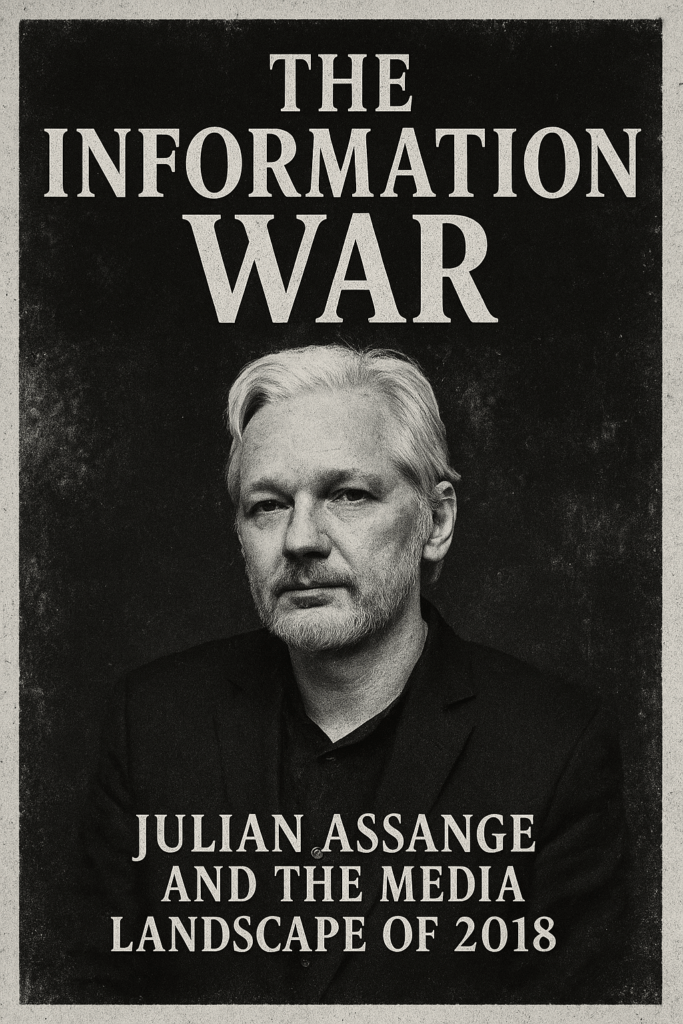
Chapter Five
By early 2018, the world was lurching from one crisis to another. Donald Trump was a year into his presidency, and Russiagate was all the U.S. media could talk about. The conspiracy had become a 24/7 circus: wall-to-wall speculation.
And it wasn’t just the news. It was everywhere. The morning shows, the late-night monologues, the podcasts, the think pieces, the bestsellers stacked high in airport bookshops. Serious political figures were quoting from them; casual viewers were absorbing it all as gospel. It was a media ecosystem working in lockstep to reinforce the same idea: that Trump was a Russian agent. Putin’s puppet, blackmailed with “kompromat.”
Take Luke Harding’s book, Collusion. It was thorough, in-depth, and written by a well-respected Guardian journalist. It sold extremely well, became a New York Times bestseller, and made Harding a wealthy man. But beneath the polish, it never actually proved collusion. What it did instead was create the feeling of collusion — the atmosphere of conspiracy, even if the hard evidence never materialised.
It wasn’t just books. The narrative bled into popular culture. At the time, I was a sucker for US TV shows. I remember watching The Good Fight, a spin-off from the popular show The Good Wife.
I had watched the whole first season amazed at how it mirrored events in the real world. The first season ended on a cliffhanger: did Russia have kompromat on the President, Donald Trump?
Season 2 dropped in February 2018, and I was floored. The storyline revolved around the infamous “pee tape,” with lawyers scrambling to represent the Democratic Party in the case.
Here was a prime-time drama, weeknight escapism, openly weaving Russiagate talking points into its storyline. It wasn’t subtle. It wasn’t allegory. It was an attempt to lodge the conspiracy deep in the psyche of anyone who tuned in, dressed up as entertainment.
And if it wasn’t Russiagate, it was Stormy Daniels — the porn star payoff became the other drumbeat of the era, filling cable news chyrons for weeks on end. The networks ran breathless coverage of hush-money payments while the U.S. was escalating wars abroad and stuffing war criminals into top cabinet posts. The absurdity was impossible to ignore: prime-time dramas pushing the “pee tape,” CNN obsessing over a porn star scandal, and meanwhile the world itself teetering on the edge of wider conflict.
The only problem was: there was no actual evidence.
It didn’t seem to matter. The corporate media were falling over themselves to promote the theory, and their viewer ratings were through the roof. Meanwhile, the subjects that actually mattered — CrowdStrike, Seth Rich, the findings of VIPS — were barely mentioned.
There were a few exceptions. Journalists like Aaron Maté kept asking the simple questions the rest of the press refused to ask — Where’s the collusion?
In one infamous exchange for The Real News on YouTube, he pressed Harding to point to the proof. Harding couldn’t. Cornered by the most basic question in journalism, he had no answer and simply ended the interview, calling Aaron a “collusion denialist.”
That isn’t journalism. It’s the opposite of journalism. It’s fairytale land. Harding didn’t just embarrass himself, he kneecapped his own profession. Luke Harding? Tonya Harding, more like.
Meanwhile, NATO was tightening the noose around Russia while strengthening their influence in Ukraine, Syria’s war had become a proxy battleground for every major power, and in Britain the headlines were dominated by the Skripal poisonings in Salisbury. And in the middle of it all, Julian Assange was still trapped in a small room in the Ecuadorian Embassy in London — already seven years into confinement, and about to be silenced completely.
The Smear Campaign Begins
Western media ran with one line and never let go:
“Assange fled to the Embassy to avoid rape charges in Sweden!”
It was a lie repeated so often it became a kind of truth — even though neither woman in Sweden had accused him of rape, neither wanted him arrested, no charges were ever brought, there was never an extradition request from outside the EAW mechanism, and even though Assange consistently said he was willing to go to Sweden, so long as he wouldn’t be sent on to the United States.
No such assurance ever came. The whole process was unprecedented. The European Arrest Warrant (EAW) issued against Assange had been signed off by Swedish prosecutor Marianne Ny, despite the fact that no criminal charges had ever been filed. Normally, an EAW is used to extradite people already charged with crimes, not simply wanted for questioning. The abuse of the mechanism was so egregious that the rules were later changed to prevent it from ever happening again.
It was never about Sweden. It was about the United States. They wanted him. And they were willing to go to enormous lengths and try every trick in the book to get him.
Nils Melzer, the UN Special Rapporteur on Torture, would later visit Assange both in the embassy and in Belmarsh prison. In The Trial of Julian Assange, Melzer showed the case was never about justice — not for Assange, not for the women, not for anyone. It was about silencing a journalist who had embarrassed the powerful.
“If the public had known the truth from the start, they would have said: ‘What? That’s it? That’s what this is all about?’ They would have seen through the whole thing. It was a giant manipulation.” — Nils Melzer, interview with Republik
Melzer made it clear: this wasn’t one rogue prosecution. It was a coordinated, state-level effort to break a man precisely because he told the truth.
Inside the Embassy Walls
Under Rafael Correa’s presidency, Assange was treated with dignity and allowed to continue his work. For seven years, despite the confinement, he carried on editing WikiLeaks, publishing truth bombs the rest of the media wouldn’t touch. The DNC leaks were just one of many major revelations to come out during that time.
WikiLeaks exposed US torture programs, mass murder, corruption, and war crimes across Iraq and Afghanistan. They also published millions of documents from every country on Earth. Since its founding, WikiLeaks has released over 10 million classified documents. Not a single one has ever been proven false. Not one.
Their model became the gold standard for source protection. They pioneered the secure whistleblower submission system that would later inspire platforms now used by media outlets worldwide.
Even inside the embassy, Assange remained active. He helped Edward Snowden evade capture in 2013 after Snowden leaked proof that the US National Security Agency was spying on, well, everyone. At home. Abroad. Illegally.
One top-secret court order, exposed in a Guardian article by Glenn Greenwald, showed that Verizon was forced to hand over “all call data” to the NSA “on an ongoing, daily basis.”
To hell with the First Amendment.
Snowden, who insisted he was defending that very amendment by exposing its violation, would have faced the death penalty had he been caught. Assange didn’t just support Snowden — he helped save his life.
As Suzie Dawson, founder of the Internet Party and a long-time Assange supporter, put it:
“Julian Assange has saved the lives of millions.”
That might sound like hyperbole. It isn’t. When you expose war crimes, you help stop them. Or at the very least, you make them harder to hide.
While under arbitrary detention in the Ecuadorian Embassy, Assange also appeared on RT, participating in interviews conducted by Afshin Rattansi on programs like Going Underground — Rattansi filmed him inside the embassy. He was also visited by John Pilger. Artists and icons came: Vivienne Westwood, Ai Weiwei — and even the King himself – Eric Cantona.
For a time, he could still do his job.
A Journalist, Silenced
That changed after Correa lost the 2017 Ecuadorian election to Lenín Moreno — a man much more palatable to Washington.
And in March 2018, just weeks after the Skripal incident, the Ecuadorian government cut Assange’s internet access, citing a supposed violation of an agreement not to comment on international affairs. The official statement claimed Assange had “put at risk the good relations [Ecuador] maintains with the United Kingdom… and with other nations.”
What had he done? He posted a three-part Twitter thread questioning the way Western powers had reacted to the supposed Russian poisoning of Sergei and Yulia Skripal — and how the response risked further escalating tensions with Moscow. The thread read:
(1/3) The manner of and timing of Russian diplomatic expulsions is poor diplomacy. The expulsions occurred 12 hours after one of the worst building fires in post-Soviet history, which killed at least 64. Russians will see the timing as gratuitous.
(2/3) That 21 US allies have expelled diplomats over an unresolved event in the UK and that the US expelled nearly three times as many diplomats as the UK, the alleged victim country, helps the Kremlin further a narrative that it is under conspiratorial siege led by the US.
(3/3) Further, while it is reasonable for Theresa May to view the Russian state as the leading suspect, so far the evidence is circumstantial & the OPCW has not yet made any independent confirmation, permitting the Kremlin push the view domestically that Russia is persecuted.
In other words, he was being… a journalist. The Guardian reported that he had “challenged Britain’s view that Russia was responsible,” even though that is literally what journalists are supposed to do in a democracy and he explicitly called Theresa May’s suspicion reasonable.
He wasn’t attacking the narrative — he was asking for proof.
Weeks after the Skripal incident, there was still no proof of Russian involvement. But the US was arming fascist factions in Ukraine, surrounding Russia with NATO forces, and fighting on the opposite side of a proxy war in Syria.
Meanwhile, in Washington:
John Bolton — a man who’d invade Narnia if someone suggested it — had just become Trump’s National Security Advisor.
Mike Pompeo, a fan of torture, was nominated for Secretary of State.
Gina Haspel, who helped destroy CIA torture tapes, was nominated to lead the CIA.
The media were an absolute joke. They had become glorified court jesters for empire, pointing in every direction but up.
And the greatest journalist of our time?
No internet. No phone. No visitors. No contact with journalists. No communication with the outside world at all.
“When you tear out a man’s tongue, you are not proving him a liar, you’re only telling the world that you fear what he might say.” — George R.R. Martin
He was still inside the embassy, but now in effective solitary confinement. If he stepped outside, he’d be arrested.
I remember a Caitlin Johnstone article around this time titled:
“We Are One False Flag Away From World War 3.”
At the time, I thought it was a bit dramatic.
I was wrong.
The US and UK governments had begun an information war. Not on Russia, or China, though. On their own populations.
They were manipulating the minds of the masses. And it wasn’t subtle.