
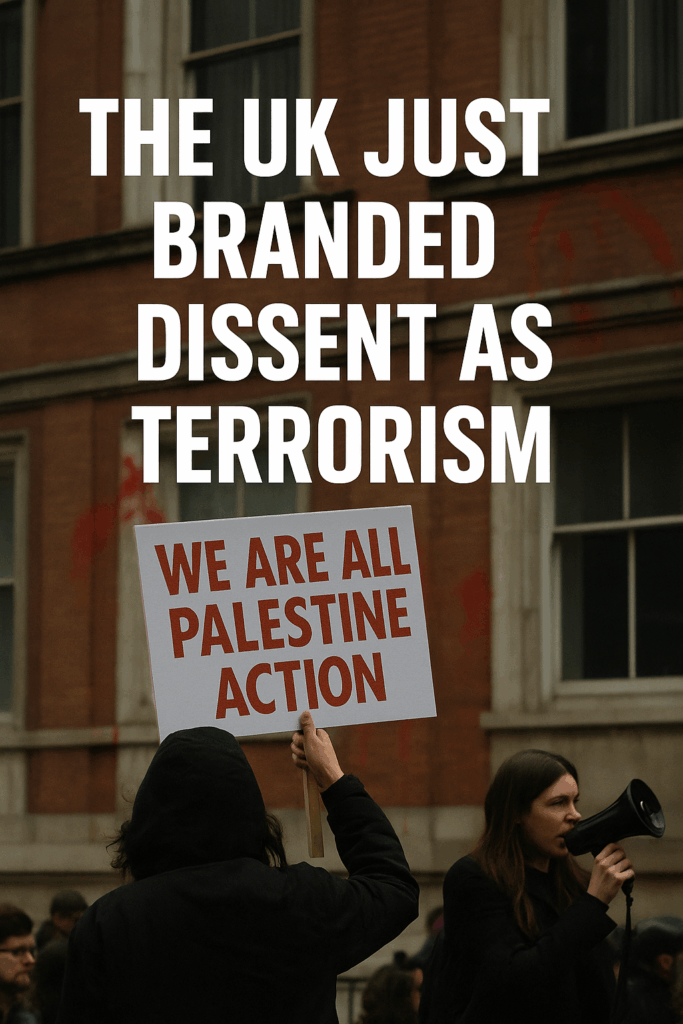
The UK Just Branded Dissent as Terrorism
On Tuesday, the UK government voted by 385 to 26 to officially proscribe Palestine Action as a terrorist organisation. If the order goes unchallenged, simply wearing a sticker, T-shirt, or sharing support for the group online could result in a terrorism charge. This marks the first time in modern UK history that a domestic protest group has been banned under counter-terror legislation.
The decision is not yet final. Palestine Action has launched a legal challenge. They will appear in the High Court at 10:30am this Friday (July 5th) to request an urgent injunction. If granted, the ban will be temporarily delayed until a full judicial review later this month.
This moment matters. And not just for Palestine Action.
What the Government Says
The Home Office claims Palestine Action engages in serious violence, that their activities are “terroristic in nature”, and that their intent is to intimidate the public. They argue the line has been crossed from protest to terrorism.
But if that’s the bar, it’s not a slippery slope—it’s a cliff edge.
Not One — Three Groups Got Banned
In addition to Palestine Action, the government proscribed two other organisations in the same parliamentary vote on 2 July 2025:
- Maniacs Murder Cult — a far-right neo-Nazi group linked to paramilitary training and murder plots.
- Russian Imperial Movement — a militant ultranationalist organisation tied to Russian-backed extremist activity.
This means Palestine Action has been placed in the same legal category as white supremacists and extremist Russian militants — alongside ISIS, al‑Qaeda, and now neo-Nazi and Russian imperialist groups.
Corbyn Challenged the Grouping — And Was Shut Down
During the Commons debate, Jeremy Corbyn formally asked that Palestine Action be voted on separately from the other two groups. He argued it was disingenuous and damaging to conflate a non-violent protest movement with organisations that promote actual extremist violence.
But the Speaker of the House refused the request, citing parliamentary procedure. The justification? “That’s not how we do things.”
So while Corbyn tried to uphold the principle that protest isn’t terrorism, procedure overruled principle.
What Liberty, Amnesty, and the UN Say
Amnesty International UK has called the move a “disturbing legal overreach,” warning that proscription could criminalise wearing a badge or sticker. Director Sacha Deshmukh told MPs:
“The question before Parliament is not whether Palestine Action’s approach is tasteful or distasteful… by the weekend, your constituents could face a terrorism charge just for wearing a T-shirt.”
Liberty and the European Legal Support Centre have also submitted formal legal support in the High Court case. They argue the government is abusing counter-terror laws to suppress political protest—calling it an authoritarian misuse of power.
UN Special Rapporteur Francesca Albanese, meanwhile, has gone further. Her report, “From Economy of Occupation to Economy of Genocide”, accuses the UK of being complicit in genocide:
“While life in Gaza is being obliterated… this report shows why Israel’s genocide continues: because it is lucrative for many.”
The Legal Context: Britain Is Bound by Treaty
Here’s the part no one on the front bench wants to talk about:
The UK is a signatory to the 1948 Genocide Convention and the Geneva Conventions. That means:
- We are legally obliged to prevent and punish genocide.
- We are also obliged not to be complicit—including through trade or arms sales.
- We must act when genocide is even alleged or suspected, as it now is by both the UN and the ICJ.
So ask yourself: if a group of activists tries to stop an arms manufacturer from fueling an alleged genocide—and our response is to call them terrorists—what does that make us?
A Warning From History
This isn’t just about Palestine. This is about precedent.
Once you can brand paint-throwing protestors as terrorists, any act of civil disobedience—from climate protests to anti-war marches—can be reclassified as a threat to national security. Once you criminalise solidarity, you dismantle dissent.
And when the law is bent to silence protest against genocide, it’s not just a moral failure. It’s a legal one.
We will look back on this vote. History will record it. The only question is which side of it we stood on.
Update pending Friday’s High Court ruling. If the injunction is granted, the proscription will be delayed. If not, it comes into force this weekend. Either way, the story isn’t over.
It’s just begun.
Support the message? Share it.
One link. One friend. One moment.


