
By Gordon Dimmack
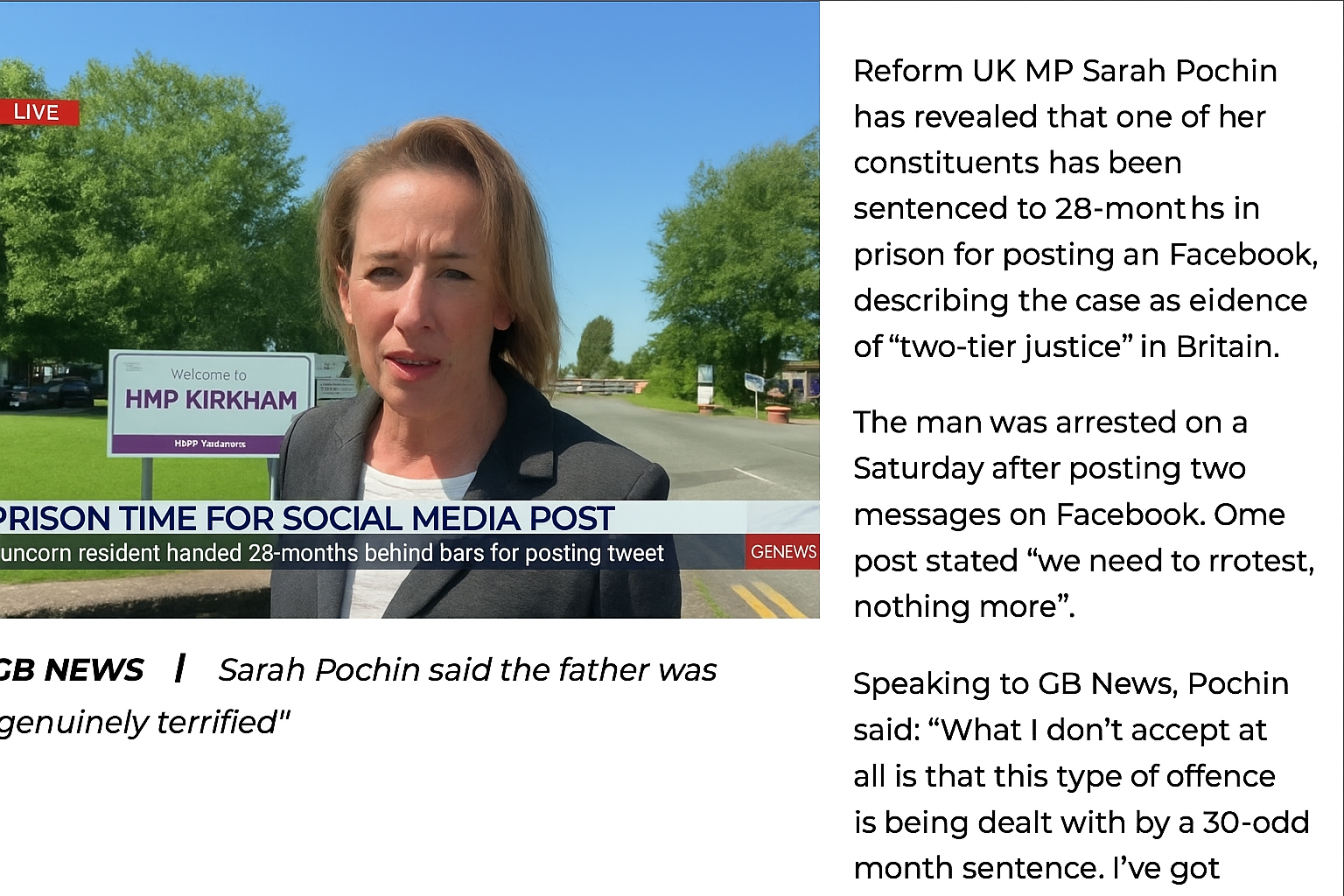
According to GB News, a man has just been jailed for posting, and I quote, “we need to protest.” That’s it, apparently. Nothing more. Say something mildly rebellious on Facebook and it’s off to prison you go.
Except… that’s not what he said. Not even close.
The truth, which they conveniently left out, is that these men were jailed for racist posts calling for people to gather “with torches and pitchforks” outside a hotel housing asylum seekers. One of them said, “We don’t want them here. F*** ‘em. They started—we will end it.” Another called them “animals.” There were multiple posts, all public, all in the days following the tragic killing of children at the Taylor Swift party—a moment already inflamed with misinformation and violence across the country.
This wasn’t just angry venting. It was incitement, plain and simple. The judge called it exactly that: timed to fuel real-world disorder, targeting a specific group. One of them even had a knuckleduster.
But here’s how GB News framed it: “All they said was we need to protest.”
Framing it like that is disingenouos to the point of absurdity. It’s like saying “All Fred West got life for… was building a patio in his back garden.”
It’s beyond dishonest. It’s propaganda dressed as concern for civil liberties.
There’s a two-tier system here. And we’re all seeing it.
Because while racists calling for mobs outside refugee shelters get two-and-a-bit years, those expressing peaceful support for Palestine are being treated like national security threats.
Some have said just seven words: “I oppose genocide. I support Palestine Action.” And now face the possibility of 14 years in prison under terrorism legislation. Not for inciting a riot. Not for calling anyone “animals” or brandishing pitchforks. But for backing a group that protests against war crimes.
This isn’t just about Palestine. Or politics. Or protest. This is about a justice system that is all over the place.
Two men who cut down a historic tree—yes, a dumb, reckless act—just got four years in prison. Meanwhile, three people who live-streamed a sexual assault in the back of a van got two. What does that tell you about the logic of this system? What does that tell victims? Survivors? Or even the average person who does something stupid one Friday night with a chainsaw and a bottle of cider too many?
I mean, for fuck’s sake! They live streamed a sexual assault! Yet they’ll do half the time that two imbeciles who cut down a tree will!
This isn’t about public safety. It’s about power picking and choosing what it punishes. And the more arbitrary it gets, the more dangerous it becomes—for everyone.
Because if the law can swing this wildly depending on who you are, what you say, or which government narrative you bump up against, then nobody is safe. And that’s why people need to get involved. This isn’t just a Palestine issue. Or a protest issue. It’s a democratic survival issue. If we don’t push back now, the same bastards who’ve already broken everything will be the ones writing the rules for what’s next.
What’s the real purpose of the GBNews article?
It’s not just sloppy journalism. It’s not even just bad faith. It’s strategic.
The GB News article plays both sides: it whips up outrage about “free speech” being under attack, while also spreading a very specific kind of fear—fear that even saying something mild online could land you in prison. Fear that paralyses people. Makes them think twice before they speak up.
But here’s the truth: this isn’t about what was said. It’s about who said it—and how the system wants to use it. If you’re backing the wrong cause, you’ll be crushed by the system. If you’re useful to their narrative, you’ll get framed as a martyr.
That’s the danger of all this. Because once these laws exist—once speech is criminalised and protest is policed at the level of thought—it doesn’t stop with Palestine Action.
We’re already seeing people stopped in the street for waving a Palestinian flag. Protesters arrested for saying “Free Gaza.” People charged for wearing a slogan on a T-shirt. The line is shifting fast. And if you think it won’t ever reach your cause—your beliefs, your identity—you haven’t been paying attention.
It starts with flag-waving activists. But before long, they’ll be knocking on your door because you’ve got a British bulldog tattoo and a dodgy meme from 2014. These laws don’t come with brakes. They come with a sledgehammer and a blank cheque.
So who are Palestine Action?
They’re not an armed group. They don’t threaten violence. As far as anyone can verify, they’ve never intentionally hurt a soul. What they do is target UK-based weapons manufacturers—especially Elbit Systems—who supply arms to Israel’s military. They do it with direct action: scaling buildings, smashing machinery, throwing paint. Symbolic disruption, not terrorism.
They’ve done this while the United Nations is begging the UK to stop arming Israel. But instead of heeding those calls, our government has chosen to criminalise the people trying to do exactly what international law demands.
Let’s be blunt: Palestine Action are not bombing buildings. They’re disrupting the supply chain that fuels the bombs. And for that, the UK state has decided they’re a terrorist group. That’s the kind of upside-down logic we’re living in.
What about the Bristol incident?
This one always pops up in online arguments. In 2022, a Palestine Action protest in Bristol led to a police officer reportedly being injured during the disruption. It’s often used as proof that the group is violent. But dig deeper, and what you’ll find is this: there’s no evidence the injury was intentional. No clear link to any coordinated attack. No confirmed violence as a tactic or policy.
And even if you take that one incident at face value—does one ambiguous case outweigh years of consistent non-violent resistance? Does it justify banning an entire movement under terrorism law?
If a climate protester scuffles with police, we don’t proscribe Greenpeace. But when it comes to Palestine, all rules vanish. Because this isn’t about security—it’s about narrative control.
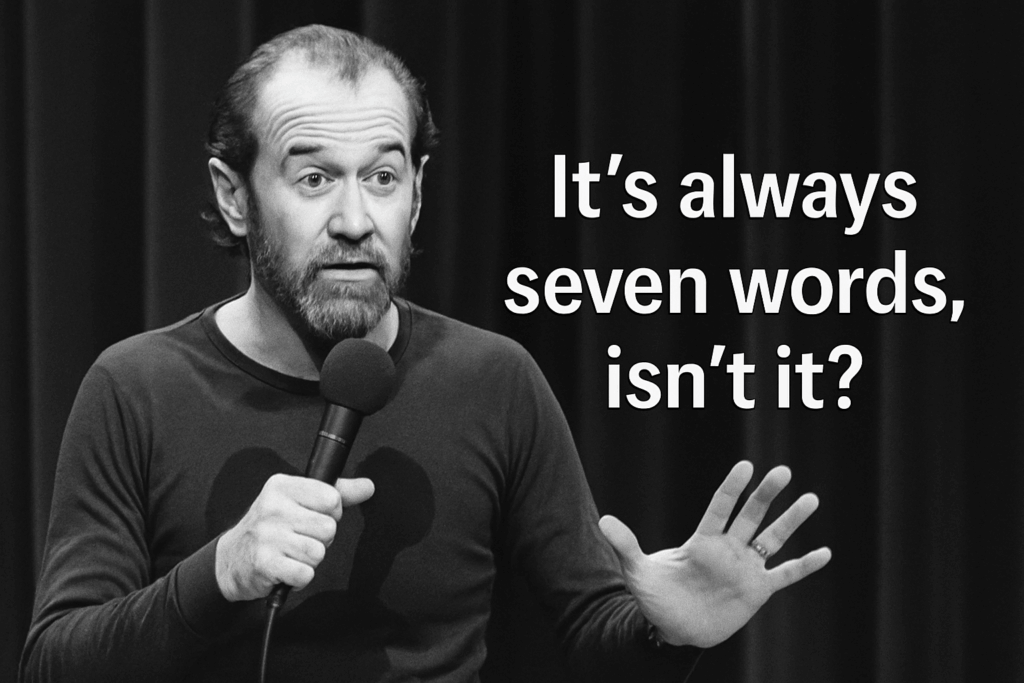
It’s always seven words, isn’t it?
In the 1970s, comedian George Carlin got arrested for performing a routine called “Seven Words You Can Never Say on Television.” It was a bit of stand-up comedy. Satire. But also a serious swipe at the absurdity of censorship. Carlin was charged with “disturbing the peace,” and the routine went all the way to the U.S. Supreme Court, where it was ruled that the government could regulate speech on public airwaves.
Now, 50 years later, people in Britain are being threatened with 14-year terrorism sentences for saying a different set of seven words: “I oppose genocide. I support Palestine Action.”
Once it was about naughty words that might offend. Now it’s about principled words that might challenge power. Same panic. Same overreach. Just a different target.
Because it’s never really about the words. It’s about who’s saying them—and what truth they threaten to expose.
This isn’t about hate. It’s about conscience.
There’s a world of difference between calling a group of refugees “animals” and standing against a military occupation. But the UK legal system seems hell-bent on blurring that line. They want people to believe that protest is dangerous. That solidarity is extremism. That your conscience is a crime.
Rowan Atkinson warned about this a decade ago—how laws meant to stop free speech would end up criminalising dissent. That those with a platform would be safe. But the rest? Fair game.
So let’s call it what it is: we’re not criminalising hate. We’re criminalising dissent. We’re criminalising opposing genocide. We’re criminalising conscience. Seven words: “I oppose genocide. I support Palestine Action.” That’s what’s being labelled terrorism now.
And the people saying it? They’re not terrorists. They’re the conscience this government is trying to silence.
And soon? It could be something your conscience cares about.
Support the message? Share it.
One link. One friend. One moment.


