
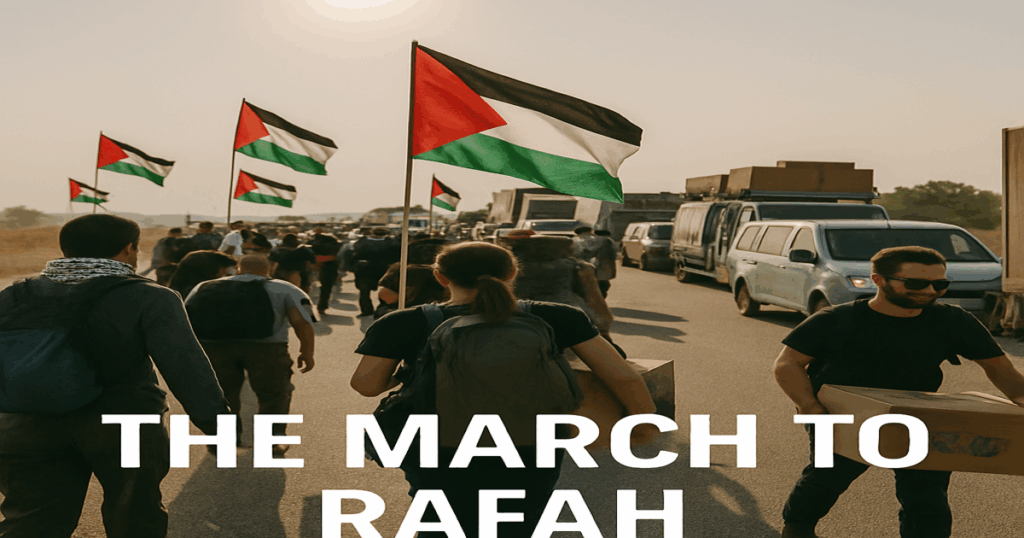
Hot on the heels of Greta Thunberg and the Madleen’s defiant sail toward Gaza, thousands of diplomats, parliamentarians and grassroots activists are now marching toward Rafah with the same mission: to break the siege of Gaza and deliver life-saving aid — on foot.
Beginning June 12, a global convoy of over 2,000 people from more than 30 countries will descend on Cairo. Their goal? To walk together to Rafah, and camp at the border with the Gaza Strip for eight days, bringing with them physical aid, moral pressure, and a clear political message: the siege must end.
This isn’t a symbolic action. It’s direct, organised civil disobedience. With sleeping bags, tents, and humanitarian supplies in hand, the marchers are demanding entry to Gaza and an end to the suffocation of its people.
The Plan
The march is coordinated by a coalition of NGOs, religious leaders, politicians, trade unionists, and civil society networks. But the marchers themselves? They’re everyday people. Nurses. Students. Pensioners. Builders. Teachers. People who have crowdfunded their flights, pooled resources to share rides across Europe, and packed their rucksacks with baby formula, dried food, and medical kits.
https://x.com/SuppressedNws/status/1931770718728966580
Over the course of eight days, the marchers will travel from Cairo to Rafah, stopping in towns and camps along the way, holding vigils and teach-ins, before establishing a mass presence at the Gaza border.
Real People. Real Solidarity.
What makes this march unique is not just the scale — it’s the type of people stepping up.
“Booked my flight to Cairo — £320. If 20 people chipped in £16, I’m there.”
— Posted in the Global Gaza March Telegram channel
A retired nurse from Germany is travelling overland via Marseille, coordinating a convoy from Berlin:
“I’ve packed my medical bag, sleeping mat and insulin. We’re aiming to cross as a peaceful presence.”
On Telegram, ride-share threads are buzzing:
“Berlin → Paris → Marseille convoy forming — one space left in the van. Bring your own tent.”
— Shared via Freedom Convoy Updates Telegram
Ghaya, a young activist documenting her journey from Tunisia, posted:
“We’re heading to Egypt. We know this might be the last time we see each other. But we’re going anyway.”
[Link to tweet]
These aren’t grandstanding influencers. They’re workers, parents, and pensioners who believe that solidarity means showing up.
The Political Pressure
The March to Rafah builds on the international momentum sparked by the Freedom Flotilla. Israel’s siege of Gaza has turned Rafah into one of the most contentious border crossings in the world. The Egyptian government, under pressure from both Israel and the U.S., has restricted movement and kept the border tightly controlled.
This march is designed to make that stance politically impossible to maintain. If thousands camp on Egypt’s doorstep — peacefully, visibly, and with cameras rolling — it becomes harder to ignore the human cost of complicity.
Meanwhile, UN Special Rapporteur Francesca Albanese has publicly called for boats from across the Mediterranean to sail to Gaza in support of the March. Her appeal is clear: that the people of Europe, and the wider world, must mobilise by sea as well as by land, and converge in solidarity to end the blockade. [Link to tweet]
What You Can Do
- Share these stories. Amplify their journey.
- Support crowdfunding efforts for travel and supplies.
- Pressure your MP or representative to publicly support an end to the blockade.
- Organise solidarity events in your own city.
This is not just a protest. It’s a movement. And it’s one the world can no longer look away from.
A Note From Me
I’ve followed these convoys for weeks. Watched students fund their flights with GoFundMe links. Saw nurses sleep on pavements with a backpack of aid. This isn’t a movement funded by power. It’s built by people. If you’re reading this, maybe you were looking for a reason to believe again. This is mine.
— Gordon