
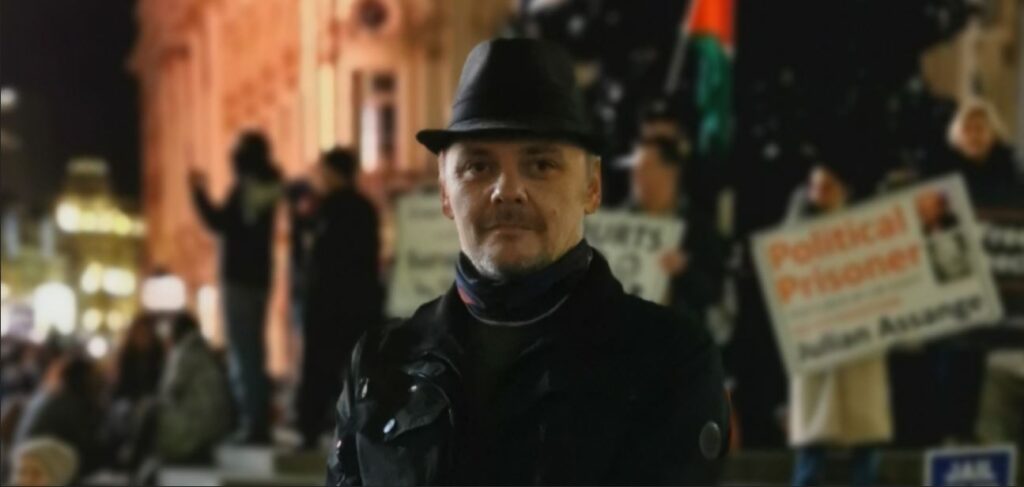
How Saying “I Oppose Genocide, I Support Palestine Action” Got Me Treated Like A Terrorist
On Thursday, August 8th, I was formally interviewed under caution by counter-terrorism police. This followed my decision last month to voluntarily hand myself in — a deliberate act of civil disobedience in protest at the UK government’s proscription of Palestine Action under the Terrorism Act.
I had prepared a written statement in advance, which was read out at the start of the interview.
📝 Prepared Statement for Police Interview Under Caution – Gordon Dimmack
My name is Gordon Dimmack. I am a journalist and political activist.
On Monday July 15th, I handed myself in as a deliberate act of peaceful civil disobedience in response to the UK government’s proscription of Palestine Action under the Terrorism Act.
I believe this proscription constitutes a serious infringement of my rights under Articles 10 and 11 of the European Convention on Human Rights — namely, the rights to freedom of expression and freedom of association.
I have not committed any criminal act. I have not incited violence.
My public statement was: “I oppose genocide. I support Palestine Action.”
That is the reason I am sitting here today. Seven words — peaceful, lawful, morally grounded — are now being treated as grounds for suspicion under terrorism legislation.I made that statement as a declaration of conscience. I did not act covertly. I did not act violently. I acted in full view of the public and the police, because I believe that silence in the face of genocide is complicity.
Palestine Action, to my knowledge, has never killed or intentionally harmed anyone. Their actions are focused on disrupting the supply chain of weapons used in what the International Court of Justice has described as a “plausible case of genocide.”
The United Nations — the very institution formed after the horrors of World War II to prevent genocide — is now begging the United Kingdom to do everything in its power to stop one from happening.
The International Court of Justice has found that there is a plausible case that Israel is committing genocide in Gaza. The UN General Assembly has passed multiple resolutions calling for a ceasefire and an end to arms sales. The UN Special Rapporteur on the situation of human rights in the Occupied Palestinian Territories has explicitly warned that we are witnessing a textbook case of genocide.
And yet, the UK government’s response has not been to act in line with those warnings. Instead, it has chosen to criminalise the people trying to stop it.
It has chosen to brand pensioners, priests, and peaceful protestors as terrorists — not because they have committed acts of terror, but because they have refused to stay silent.
The proscription of Palestine Action is, in my view, a political move — not a legal necessity. No terrorism charges have been brought against the founders of the group, and no evidence has been publicly presented that would justify meeting the threshold under Section 1 of the Terrorism Act 2000. In the absence of such evidence, criminalising support for this group appears to be the criminalisation of belief itself — not of action.
This sets a dangerous precedent: where peaceful opposition to war crimes and genocide is reframed as extremism, and words themselves are treated as offences.
I have written extensively about these matters on my blog and social media platforms. My views are not secret. I do not hide what I believe. I act openly, without violence, and in accordance with both my conscience and international legal obligations.
I would also remind the officers conducting this interview that the police are bound by the Human Rights Act 1998 to act in accordance with the European Convention on Human Rights. Upholding these rights — including freedom of expression and freedom of association — is not optional. It is a statutory duty. Criminalising peaceful speech, absent any evidence of incitement or violence, runs contrary to that duty and undermines public trust in both the law and those who enforce it.
I understand that the officer sitting opposite me may not have chosen this case, and I want to say this clearly: I don’t view you as the enemy. I know you’re doing your job. But doing one’s job has never been a shield from moral accountability — especially not during times like these.
Across this country, we are now seeing 83-year-old priests, pensioners, and peaceful protesters being arrested under the Terrorism Act. Not for committing terrorism — but for saying seven words: “I oppose genocide. I support Palestine Action.”
Calling elderly citizens terrorists for opposing genocide is not law enforcement — it’s political repression. Every officer involved in these arrests should take a moment to reflect on what duty really means.
Your role — your oath — is to protect the public, uphold the law, and defend human rights. Those duties don’t dissolve when orders come down from above. In fact, it’s in moments like this — when law is used to crush conscience — that your duty matters most.
I believe that one day, these arrests will be remembered not with pride, but with shame. They will be studied — not in history museums, but in museums that document injustice. And I don’t say that to provoke you. I say it as someone who still hopes it’s not too late to stop it.
So I ask you — the person sitting in front of me right now — what are you going to do?
When you look back on this moment, will you be able to say you stood for what was right?
Will you be a picture in a museum — not as a warning, but as someone who took a stand?Because history does not just remember those who gave the orders. It remembers those who carried them out — or refused to.
I’m standing up today because I believe in something bigger than myself. But I shouldn’t be standing alone. If the law is to have any meaning, then everyone who swears an oath to uphold it — including the police — must also stand up when that law is being twisted into a weapon.
I make this statement in good faith. I will not be answering any further questions at this time and refer to this statement as my full response.
🗒️ Post-Interview Analysis
I exercised my legal right to answer “no comment” to every one of the 30 or so questions put to me during the interview — with two exceptions. When asked whether I had written the statement myself, I answered “yes.” When asked if I supported Hamas, I replied: “No comment, Piers Morgan.” My solicitor and I burst out laughing. The officers did not.
Officer’s question: “Do you support Hamas?”
My answer: “No comment, Piers Morgan.”
Much of the interview was boilerplate. “Have you ever met the founders of Palestine Action?”, that sort of thing. The only real pushback to my statement came in response to my assertion that Palestine Action does not meet the terrorism threshold. The officer claimed I had stated there was no evidence, to which my solicitor clarified: “He didn’t say there was no evidence. He said it doesn’t meet the threshold.”
The officer went on to cite the Brize Norton incident as justification for the group’s proscription. But, as journalist John McEvoy has revealed — and as I’ve reported in previous blog posts — the UK government had already decided to proscribe Palestine Action before that incident occurred. The threshold narrative is being retroactively constructed.
I was officially cautioned under Section 12 of the Terrorism Act — the section that criminalises membership, support, or association with a proscribed organisation. It carries a maximum sentence of 14 years in prison.
Let me be clear: I crossed this threshold on purpose. Not out of recklessness, but because I believe the law itself is being twisted into a political weapon. That is the real danger — not me, or my blog, or my words.
🧭 Closing Reflection
I didn’t do this looking for martyrdom. I did it because I refuse to live in a country where opposing genocide is treated as extremism — where saying “I oppose genocide” is enough to bring you under police suspicion, while arming the perpetrators of that genocide gets you a seat in Cabinet.
I’m fully aware of the legal risks — including the very real possibility that this could backfire spectacularly. I know how the system works. I know how they say “don’t worry,” only to drop the hammer six months later. But I also know that if no one is willing to stand up and say “enough,” this machinery of repression will keep rolling over everyone in its path.
My conscience is clear. My actions were peaceful, open, and principled. I crossed their line because their line is in the wrong place. And if standing up for humanity makes me a criminal in the eyes of the state, then it’s the law — not me — that needs defending.
I was allowed to leave without being charged with any offence, and with my head held high.
Support the message? Share it.
One link. One friend. One moment.


