
Update: This article was originally published at 1pm GMT on June 13. It will be updated as the situation unfolds, including verified reports of strikes on Tehran airport and Iranian retaliation
Yesterday morning, the IAEA announced that Iran appears to be enriching uranium at previously undeclared facilities. If true, it would mark the first time in 20 years they’ve done this—potentially a breach of the nuclear deal. Cue the headlines: Iran is on the path to a nuclear weapon.
But we’ve heard this all before.
I remember hearing Israeli leaders warning about an Iranian bomb back in the early 1980s. Every few years, there’s another alarm bell, another prediction. And yet—no bomb.
So why am I talking about it now?
Well, timing is everything. And for Netanyahu, timing is survival. As soon as the war in Gaza ends, his political shield vanishes. He’s facing corruption charges. He knows it. Everyone knows it. If this war stops, he’s either out of office or on trial—or both. His only way forward is to keep the war going.
And now we know how he plans to do it. Escalate to war with Iran.
Yesterday, just before Natanyahu ordered air strikes on Iran, Iran began releasing documents it claims to have hacked from Israeli nuclear research centers—potentially including material linked to the Soreq facility. While the IAEA has yet to authenticate the files, the timing is impossible to ignore. These leaks suggest that Israel’s undeclared nuclear arsenal—and the double standards surrounding it—are finally being dragged into the open.
View the alleged leaked documents on Telegram: t.me/PalestineResist/78291
It also raises serious questions about the IAEA’s role. It’s worth remembering: Israel never signed the Nuclear Non-Proliferation Treaty and isn’t subject to full IAEA inspections. Iran is. That means the IAEA can publicly condemn Iran, but not Israel—even though Israel is the only nuclear-armed state in the region. That’s not oversight. That’s a loophole by design. If Netanyahu can launch airstrikes and then point to the IAEA report as justification, was the report a neutral finding—or a pretext prepared for a war already in motion? The IAEA’s silence on Israel’s own stockpile only reinforces the suspicion that this is not impartial monitoring, but nuclear policing written in Tel Aviv.
Overnight, Israel finally launched the airstrikes on Iranian territory that had been warned of for days. Netanyahu confirmed they were a direct response to the IAEA report accusing Iran of breaching nuclear protocol. Iran responded by launching over 100 drones—likely just the first wave.
The U.S. says it wasn’t involved. Of course it wasn’t. It was just their planes, their weapons, their regional radar systems. Reports from multiple sources suggest both U.S. and UK warplanes were scrambled to shoot down Iranian drones. So while Washington denies pulling the trigger, Israel clearly knew they’d be shielded.
This was never going to be a fair fight.
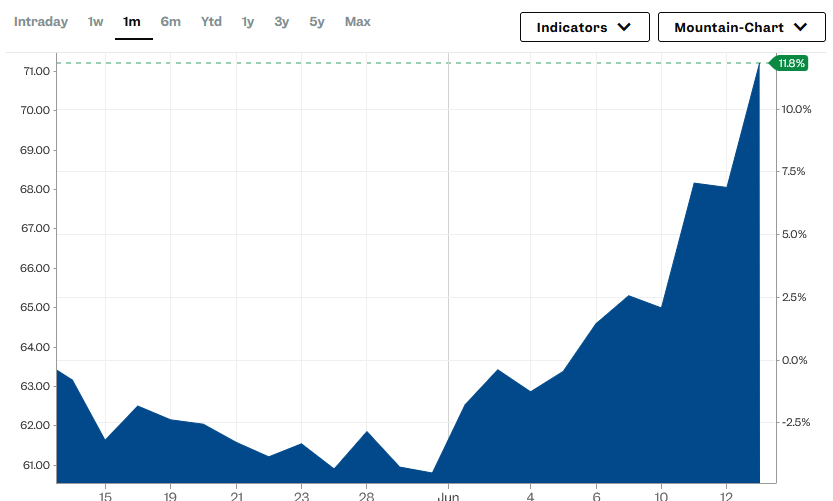
And now we’re learning the strikes may have killed several senior IRGC officials. If confirmed, that alone could provoke a sustained Iranian retaliation. Markets certainly believe it—Brent crude spiked dramatically after the strikes, jumping from $70.41 to over $78 a barrel in hours.
Visual: Brent crude price surge after strikes
But this story didn’t begin with missiles. It started with leaks. Iran claims to have hacked and acquired Israeli nuclear documents, threatening to release them. The authenticity is still being verified—but they’re being posted, and the symbolism is clear: Iran is calling Israel’s nuclear bluff. And now, the bombs are falling.
So where does it go from here?
Iran has long warned it could target oil infrastructure in the Gulf. If that happens, we’re not just looking at war—we’re looking at a global economic crisis. And while eyes are fixed on Iran, let’s not forget: Israel cut Gaza’s internet just before the strikes began. We are now seeing images of entire Gaza districts on fire—no coverage, no live feeds, no accountability. What else has happened there, while the world looked away?
Meanwhile, U.S. President Donald Trump has issued his own threat to Iran:
“Make a deal or there will be nothing left.”
— Donald Trump, The Telegraph“Even more brutal” attacks planned if Iran doesn’t agree.
— Sky News
Two quotes. One message. This isn’t negotiation—it’s nuclear blackmail.
Trump’s trying to give them an offer they can’t refuse.
This is mafia politics—drones and diplomacy hand in hand. Israel bombs. Trump threatens. And Iran is told to crawl to the table in Qatar this weekend and sign.
According to Axios two Israeli officials claim Trump was only pretending to oppose Israeli strikes on Iran in Public. Behind the scenes, they say, he was fully aligned. It wasn’t opposition–it was theatre.
Trump’s newly appointed U.S. ambassador to Israel, Mike Huckabee, said he had to take shelter five times during the overnight Iranian response. And yet, earlier this week, Huckabee declared that the U.S. no longer supports a Palestinian state as a policy objective—suggesting instead that it could be created “somewhere in the Middle East.”
OpenSecrets data shows pro-Israel donors gave thousands to Huckabee during his presidential runs, and his own Huck PAC hauled in $11 million in 2024—funneled into Republicans tied to Israel’s agenda. This isn’t mere diplomacy. It’s a network of political influence reinforcing U.S.–Israel policy coordination at every turn.
So much for Trump being “anti-war” and putting a stop to those “stupid wars in the middle east”, eh? MAGA?
With all this in mind, I have to ask an uncomfortable question: Are nukes the path to peace in the Middle East?
Because right now, it looks like the only way to survive is to have them. If you don’t, you get bombed, blackmailed, and blockaded. If you do, suddenly the world listens.
There is no way in hell that any of this would happen if these countries knew Iran had nuclear weapons. Israel has them, though. And that nuclear arsenal is what gives them the power to dominate the region, along with the support of Western powers. This has allowed Israel to commit heinous crimes on the Palestinians and bomb it’s neighbours with almost impunity in ways that future generations will study as one of the darkest periods in history.
If peace is ever going to be possible in the Middle East, it can’t be built on mafia threats and nuclear hypocrisy. It has to start with justice. With equal rules. With human rights that apply to everyone—Israeli, Iranian, and Palestinian alike.
Until then, this doesn’t look like peace.
It looks like war.