
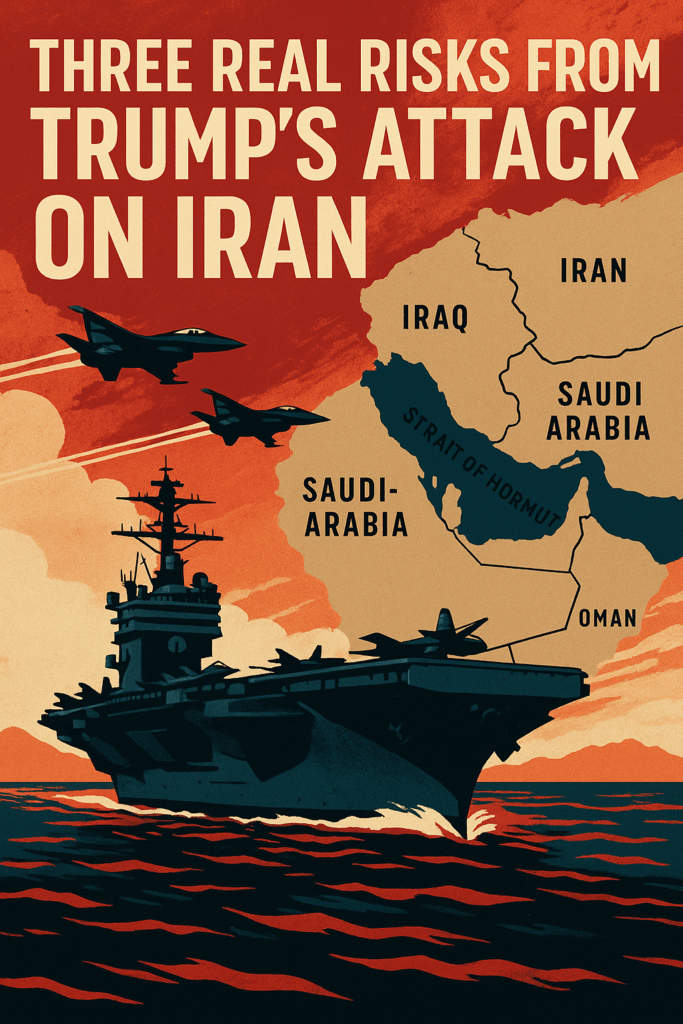
Broken Arrows and Boomerangs: The Day Trump Bombed Iran
By Gordon Dimmack
Published: June 22, 2025
1. What Just Happened?
Donald Trump just dragged the world into dangerous new territory. This article breaks down the risks, the lies, and the fuse that is now burning at both ends
Trump bombed Iran. Not in theory. Not in some off-screen clandestine operation. Not with plausible deniability or a sneaky wink across a diplomatic table. He actually did it. Airstrikes. Missiles. Warplanes. American aggression now has a fresh crater to point to. How damaging these strikes were on Iran’s nuclear facilities is unclear. What is clear, though, is that Iran will retaliate in kind. This action by the United States will boomerang back on them. The only question is, how?
This isn’t just a geopolitical headline—it’s a seismic shift. And despite all the distractions and smoke screens, there’s one truth we can’t ignore:
This was the moment the world got closer to all-out war than it has in decades.
But here’s the twist—this war might not play out how Washington thinks it will.
2. In the Crosshairs: The Strait of Hormuz
Iran has warned several times that any direct attack by the US will illicit a strong retaliation. The US has 50,000 troops and around 20 bases in the Middle East. Many are closer to Iran than Israel and none have an Iron Dome defense system to protect them. These bases, along with the ships in the region, are effectively defenseless against Iranian next-gen hypersonic missiles.
Those ships may be awesome feats of engineering which possess an incredible amount of firepower, but they’re also sitting ducks.
While Iran knows American troops being sent home in body bags will massively increase pressure on Donald Trump at home, who is under fire from every angle including his most ardent supporters, they also know an act of aggression on US troops may have the opposite effect, solidifying support behind him ala Bush 2001. Any dead US soldiers would be met by a devastating military response. With this in mind, their response must be calculated.
Roughly 20% of the world’s oil flows through the Strait of Hormuz. A narrow stretch of waterway which Iran could close overnight.
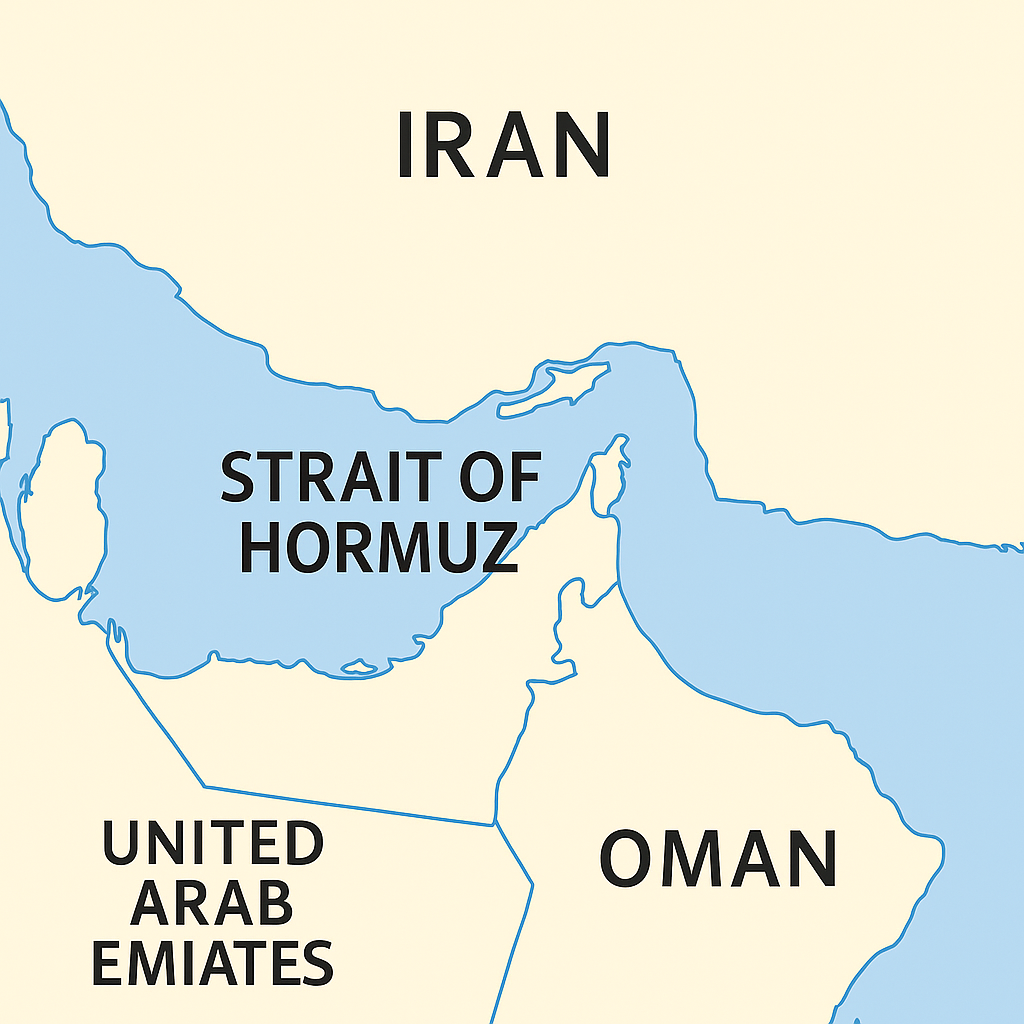
One missile, one sunken tanker, one false flag—and the global economy shudders. Not just rising petrol prices. We’re talking supply chain collapse, inflation spikes, and geopolitical chaos. And yes, even food insecurity in the Gulf states.
Iran has threatened for years to close the Strait if attacked. Western analysts brushed it off as bluster. But what if it’s not?
And what if—just like Nord Stream—we never get a clear culprit for the spark that shuts it down? One well-placed explosion, blamed on “Iranian-backed militants,” and suddenly the narrative writes itself. Justification for escalation. Justification for more bombs, more arms deals, more surveillance, and more war, with more state actors intervening as the world takes sides.
And as always—ordinary people pay the price.
3. The “Red Line” Rhetoric
There’s a phrase that keeps surfacing from the mouths of Western officials and Israeli spokespeople: “We have drawn a red line.”
It’s the same language used before every major escalation in modern war. It was said before the invasion of Iraq. It was said before NATO bombed Libya. It was used when Syria was accused of chemical attacks.
And now it’s being used to frame Iran.
It’s meaningless, of course. Murdering children is a red line. Starving millions of innocent people is a red line. Bombing hospitals is a red line. Ethnic cleansing is a red line. Apartheid is a red line. Genocide is a red line.
These are real red lines. All else is rhetoric. Theatre. A warning bellowed by those itching for it to be crossed.
The phrase “red line” is not just a warning—it’s a trap. It creates a narrative that any response, any hesitation, any attempt at diplomacy is a betrayal of principle. It turns a complex geopolitical standoff into a zero-sum moral dilemma. Act or be weak. Bomb or be complicit.
It’s also conveniently vague. Who drew the line? Where was it drawn? And who benefits from it being crossed?
The answer is almost always the same: weapons contractors, political opportunists, and media outlets hungry for war-driven engagement.
So the next time you hear a Western leader or pundit say “red line,” ask yourself:
Whose blood are they willing to spill to keep their credibility intact?
4. The USS Nimitz and the Game of Escalation
Let’s talk about the floating monster sitting in the Gulf of Oman. The USS Nimitz—one of the most powerful aircraft carriers ever built—is now in striking distance of Iranian territory.
It’s meant to project dominance. But it also paints a giant target. The message is clear: “We’re not bluffing.”
But neither is Iran. They’ve developed advanced anti-ship missiles specifically for this kind of scenario.
This is a game of escalation chicken. One wrong move, and it’s not just the Strait of Hormuz that shuts down. It’s the rules-based international order that collapses—because rules mean nothing when everyone is armed and afraid.
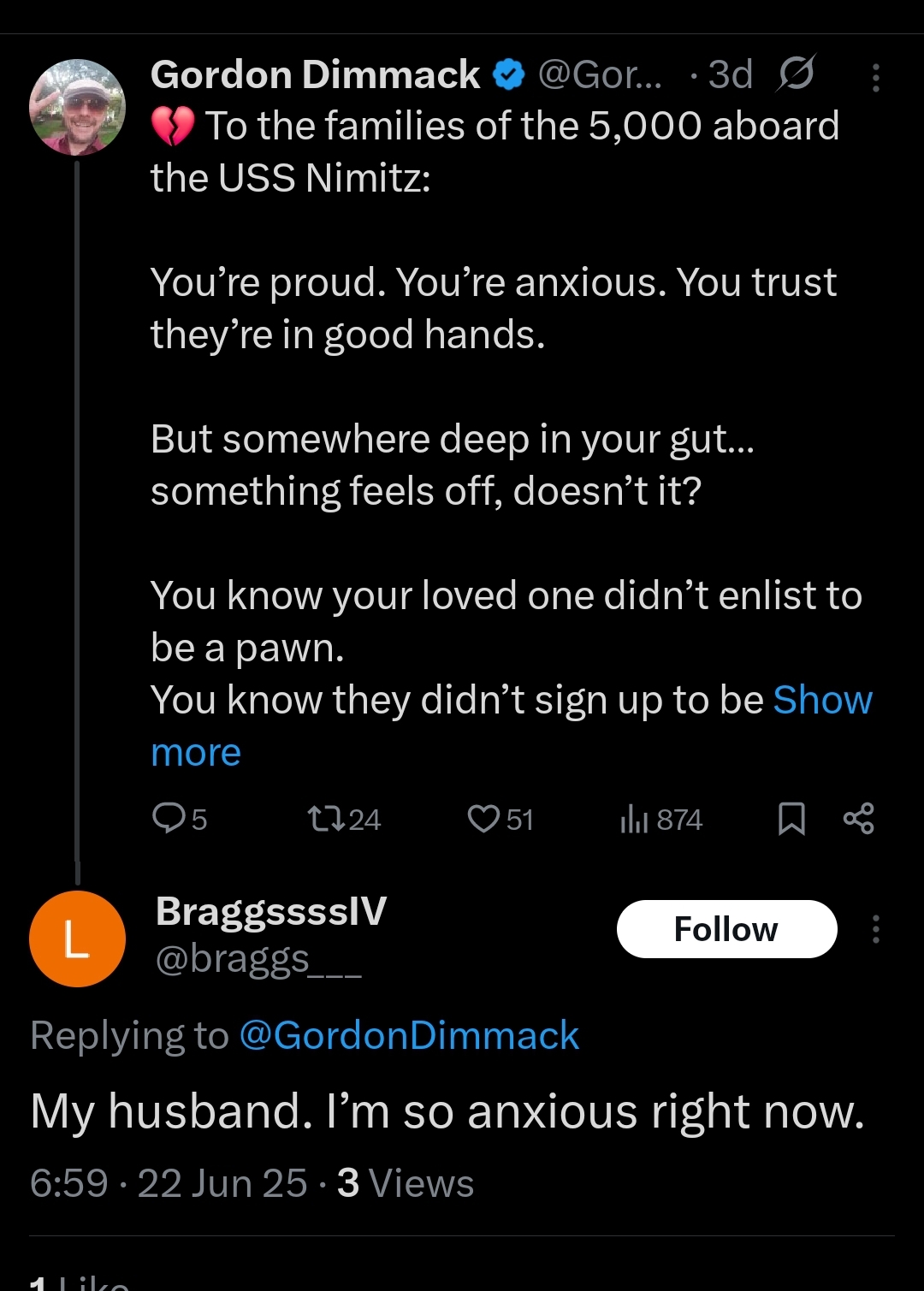
And the people who suffer? They’re not in Washington. They’re the families in Bahrain. The workers in Dubai. The sailors’ wives back in Florida, tweeting in fear:
5. Tulsi, Trump and the Nuclear Elephant
Tulsi Gabbard used to scream about this exact scenario. When Trump last held office, she was one of the few voices warning of a “pretext for war with Iran.”
Now? She’s fallen in line. “Iran is the aggressor,” she says—parroting the same State Department line she once challenged.
It’s disheartening. Because Tulsi stood for something. She broke ranks. She spoke up. And now, when it matters most, she’s vanished into political safety.
My honest opinion? Tulsi Gabbard should resign. Not because she’s weak. But because resignation isn’t surrender. It’s a megaphone. A chance to speak outside party lines. To lead again, not follow.
And right now, the world needs warriors of truth—not soldiers of convenience. Iran doesn’t have a nuke, in my opinion. Israel does. Israel is the nuclear threat. But it is clear the West are attempting to make it look like the opposite to be the case. And Gabbard is playing along.
Conclusion: Broken Arrows, Broken Systems
A “broken arrow” is the military’s term for a lost, stolen, or compromised nuclear weapon. The term should haunt us—not just for what it means technically, but what it means metaphorically.
If Israel collapses—and many believe it is collapsing right now—what happens to the nuclear weapons it refuses to admit it even has? Who keeps them safe? Who tracks them? Who prevents a “loose nuke” nightmare scenario?
It’s not a rhetorical question. Because the very people who push war, who shout “red lines,” who send carriers to hostile waters—they never think about the fallout.
They only ever think about the crater. But the crater is just the beginning.
Israel made a major miscalculation when they attacked Iran. They didn’t realise the power of Iran’s arsenal. And now, as Israelis scream “war crime!” and hide in tunnels as missiles rain down on their heads, acting the victim after a small taster of their own medicine, the world recoiled with derision.
We remember their crimes. We remember all of those images of dead, headless children. Of babies left in incubators to rot. Of dogs feasting on the corpses of the innocent. Of the starving masses being mowed down like a scene from The Hunger Games. The ghosts of Gaza are global now. And it seems the world is firmly behind Iran as a result.
In conclusion, we are in a dangerous period. This powderkeg could explode at any time. The real risk is this: the Strait of Hormuz closes. The world economy spirals. Panic spreads. Shelves empty. And in that chaos, broken systems drop their broken arrows. But when the smoke clears, if it clears at all, history will remember who fired first. History will remember who lit the fuse.
And it wasn’t Iran.