
Chapter One
This is Chapter One of my book.
I’ll be publishing a new chapter each week right here on the blog—no paywall, no marketing funnel, just truth.
If you want to help me finish it, there’s a donation link at the bottom. Every bit of support helps keep this going.
“The rough draft of Western history will not make it to publication.” – Shahid Bolsen
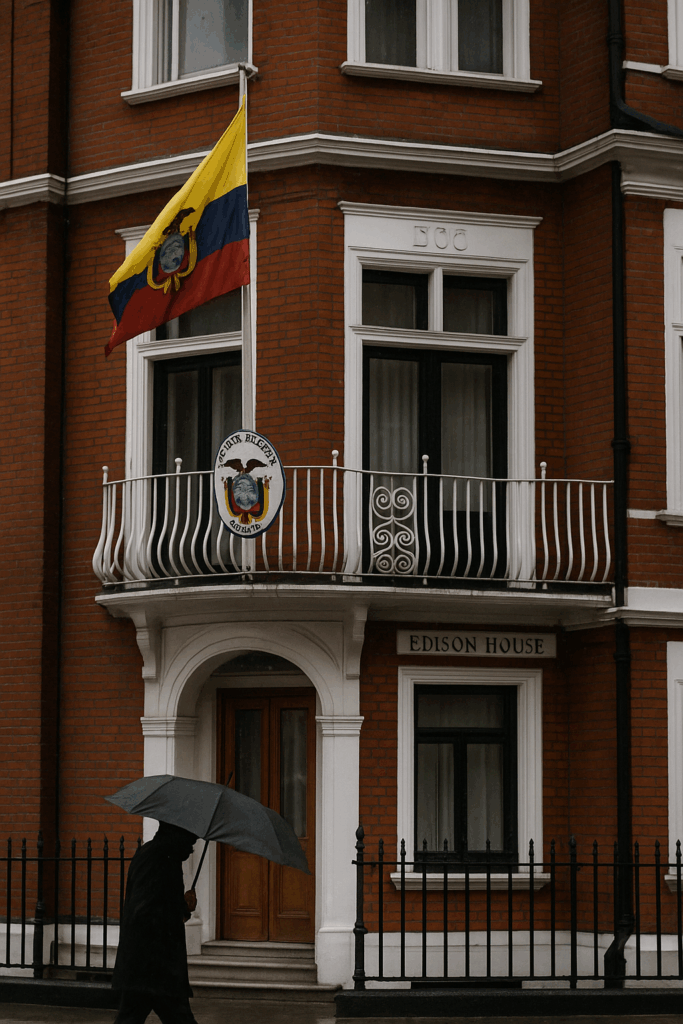
There I was—outside the Ecuadorian Embassy in Knightsbridge—about to give a speech in defence of Julian Assange. It was a wet, bone-cold spring day in 2018. It all felt surreal. Not just the nerves—but the sudden realisation it had come to this.
Me. A bloke from the Midlands. No journalism degree. No media training. Just a YouTube channel, a few thousand subscribers, and a growing certainty that truth had become contraband.
To understand how I ended up there, you have to go back about eighteen months—back to the day Trump won the 2016 election.
I wasn’t political. I wasn’t even particularly informed. But I remember watching CNN and thinking: something’s broken. One day they’d trumpet certainty, the next they’d declare the opposite—and no one asked why. The lies weren’t subtle. They were brazen. And everyone just played along.
That was the moment the floor cracked.
So I typed “independent media” into Google—just looking for someone, anyone, who wasn’t pretending. I found The Young Turks first, and for a while they seemed like the antidote. Then I stumbled onto Jimmy Dore. And something clicked.
Jimmy didn’t sound like a pundit. He sounded like a human being. Angry, skeptical, and real. It was like hearing someone finally say out loud what I’d been quietly thinking.
That’s when I realised: it’s not just that the media gets things wrong—they leave out what matters. On purpose.
A few months later I hit ‘record’. Not because I craved the spotlight—I hate it—but silence felt like complicity. I’m shy by nature. Reserved. I hate being in front of a camera. But watching story after story buried, twisted, or erased… something snapped.
Independent creators were being crushed—demonetised, blacklisted, algorithmically disappeared. They called it the Adpocalypse.
But even knowing it would be a struggle, I felt like I had no choice. If you’ve got a voice and you see the truth getting throttled, staying quiet isn’t neutrality. It’s surrender.
We were heading for something dark. And if I was going to be any kind of man, I had to speak.
One of my early videos—calling out The Young Turks for selling out to Katzenberg and sidelining Jimmy—went viral. Turns out I wasn’t the only one seeing the cracks.
By early 2018, I was covering political stories full-time. It wasn’t easy, but I was scraping by—just enough to pay rent and keep the wolf from the door. That’s when I got interested in the Assange case.
And the deeper I looked, the more disgusted I became.
The media had turned his story into farce. They focused on his cat, or his laundry, or a warped version of a Swedish investigation that never even led to charges. They left out the one thing that mattered:
Julian had been trapped in that embassy for over six years. Not hiding. Not evading justice. Seeking asylum—from the world’s most powerful empire, who wanted him destroyed for telling the truth.
Wikileaks didn’t just publish secrets. They exposed crimes. War crimes. And they did it with a perfect record—no retractions, no spin. Just raw, verified evidence.
So I told my audience: if they could cover my travel costs, I’d go to London and report from the embassy rally myself.
A dozen people chipped in. One of them was a woman named Hitch—£20 on Super Chat. I clicked her profile and saw her grinning in a picture, giving a cheeky “Fonz” thumbs-up.
When I got to the embassy, she was there. Same pose.
“So, I’m Hitch!” she said, with a grin that made you forget how cold it was.
She was also stunning. That helped.
Emmy Butlin from the Julian Assange Action Committee asked if I’d speak at the rally. I nearly turned her down. I’d never addressed a crowd before—and to make matters worse, George Galloway was on after me.
It felt like being asked to open for Chappelle.
I was terrified. Hitch leaned in.
“If you’re nervous, picture the crowd naked,” she said.
“Can’t,” I replied. “One look at you and I’ll get an erection.”
She laughed. We hit it off instantly.
And then Galloway arrived. As the crowd mobbed him, I waited for a quiet moment and shook his hand.
“I follow you on Twitter,” he said casually.
As if that was normal.
At the time, I had a few thousand subscribers. No credentials. And yet, somehow, I was about to speak outside the Ecuadorian Embassy—while the most famous journalist in the world sat imprisoned inside.
It was surreal. But not because I was speaking.
It was surreal because no one else was.
The UK media had vanished. Or worse, they’d turned executioner. The press wasn’t just silent—it was complicit.
That’s the part that enraged me.
I wasn’t there because I was good at journalism. I was there because everyone else was too afraid.
The risk was obvious. Speak up for Julian and you were done. You’d never work at the BBC. Never write for the Guardian. You’d be blacklisted. Mocked. Smeared. Maybe even arrested.
So they stayed quiet. Or they joined in. Wrote stories about rape charges that never existed. Said he didn’t clean up after himself. Claimed he mistreated his cat.
Pays better than truth, apparently.
I’ve called them spineless before. That’s not quite fair. They had every reason to be afraid.
Because the message from the US and UK governments was crystal clear:
“Legality doesn’t matter. Morality doesn’t matter. If you publish documents that expose our crimes, we’ll ruin you.”
That message wasn’t just for Julian. It was for every journalist still breathing.
And that’s why I stood up—not as a professional, but as a citizen.
Because the Fourth Estate wasn’t just failing.
It was being smothered.
Deliberately. Publicly.
The free press wasn’t asleep.
It was in exile.
Inside that embassy.
I don’t have footage of my speech that day. But I remember what I said:
That Wikileaks had dragged journalism out of the analogue era and into the digital one—and done it flawlessly.
That Assange didn’t just publish raw, undeniable facts.
He digitised the Fourth Estate.
And for that, they had to silence him.
The rally ended. The crowd drifted. I got the train home, back to the West Midlands.
But I wasn’t the same.
Because I knew this wasn’t just about a man.
It was about the truth.
It was about democracy.
And both were being taken from us.
I did get Hitch’s phone number that day, though. So it wasn’t all bad.
Numbers exchanged. Mission accomplished.
But I knew the hard work had only just begun.
Support the message? Share it.
One link. One friend. One moment.


