
32 States Target Israel’s War Machine
By Gordon Dimmack
It’s not just economic pressure anymore. It’s a coordinated siege.
32 countries have formed in an attempt to impose an embargo on Israel, aiming squarely at the backbone of its war machine. And it’s not just about arms or ammunition — this is a sweeping blockade targeting goods, trade, infrastructure, and the legitimacy of Israel’s war economy.
It’s hard to overstate how significant this is.
This is no longer just about protest. It’s about power.
Who’s In and Who’s Watching
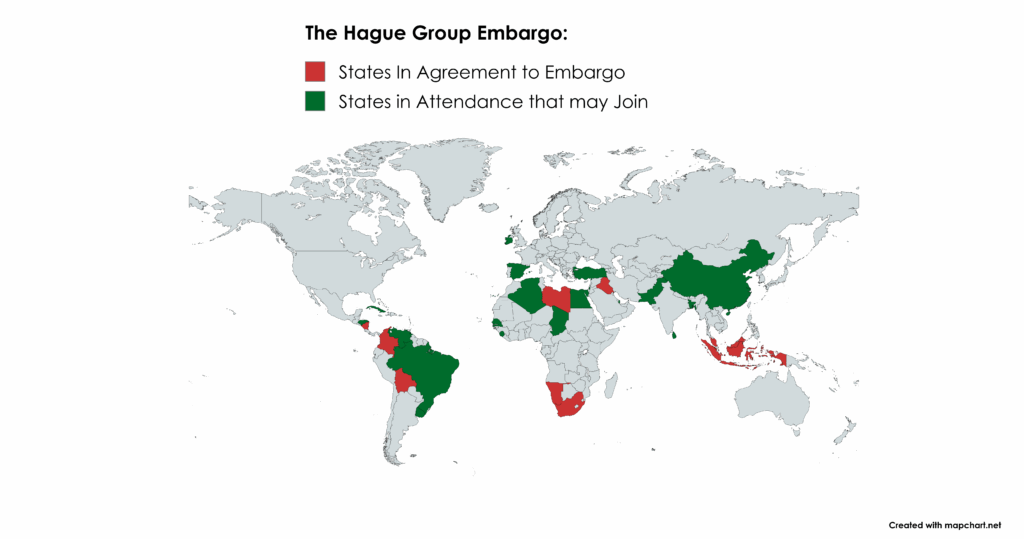
The Hague summit brought together a stunning cross-section of the Global South — from South America and Africa to Asia and the Middle East. Twelve states signed the agreement to impose a coordinated embargo. A further twenty nations attended but held off on signing, at least for now. These include regional giants like China, Brazil, and Indonesia, who may be playing the long game — applying pressure, watching the response, and weighing their options.
That’s the diplomatic way of saying: this might only be the beginning.
Some of the attending countries are major shipping hubs, oil exporters, rare mineral providers, and overland route controllers. If even a handful of them join the embargo formally, Israel’s trade routes and resupply networks — particularly for industrial, tech, and military sectors — start to shrink dramatically.
The image below maps the world split between signatories and potential joiners:
Strategic Supply Chokepoints Are Forming
This map doesn’t just show diplomatic tensions — it shows logistical consequences in real time.
The states marked in red have already agreed to impose an embargo on Israel. The green states attended the Hague Group summit and may soon follow. Together, they stretch across key maritime and land corridors that Israel depends on — not just for exports, but for importing everything from fuel to microchips.
The effects won’t be symbolic.
If enforced, this embargo hits strategic maritime chokepoints:
- ⚓ Suez Canal (Egypt): Israel’s fastest access to Europe.
- ⚓ Bab el-Mandeb Strait (Yemen/Djibouti): Gateway to the Red Sea.
- ⚓ Strait of Hormuz (Oman/Iran): Vital oil flow region.
- ⚓ Cape of Good Hope (South Africa): Reroute point if Suez is blocked.
- ⚓ Panama Canal (Panama): Atlantic–Pacific shortcut, now in doubt.
- ⚓ Strait of Malacca (Malaysia/Indonesia): Key link in Asia–Middle East–Europe supply chain.
If even two or three more green states join, Israel risks becoming surrounded by red tape, legal threat, and logistical blockade — unable to dock at critical ports or traverse safe routes.
This is the economic equivalent of encirclement.
This Isn’t Just BDS — This Is BDS on Steroids
Let’s be absolutely clear: every single one of us should be boycotting, divesting, and sanctioning.
We should be boycotting companies like McDonald’s. We should be unfollowing celebrities who are vocally supporting Israel or staying silent on the genocide. We should be cutting ties with corporations and influencers who continue to legitimise apartheid.
We should all be doing this.
But what’s happening here isn’t just individual resistance. It’s systemic action. This is BDS on steroids.
This isn’t just about choking the supply of goods —
It’s about choking the supply lines themselves.
The pipes are being turned off. The doors are being locked. The legal and political cost of doing business with Israel is starting to outweigh the benefit — and that’s what makes this different.
This is not just moral pressure. It’s structural.
And it’s spreading.
And It’s Just the Beginning
The world is closing its ports. The legal walls are going up.
Israel’s impunity is being embargoed — one lane, one deal, one country at a time.
This is exactly how apartheid in South Africa was brought to its end.
Not all at once.
But enough — until the system couldn’t breathe.
And now, it’s happening again.
Support the message? Share it.
One link. One friend. One moment.


